

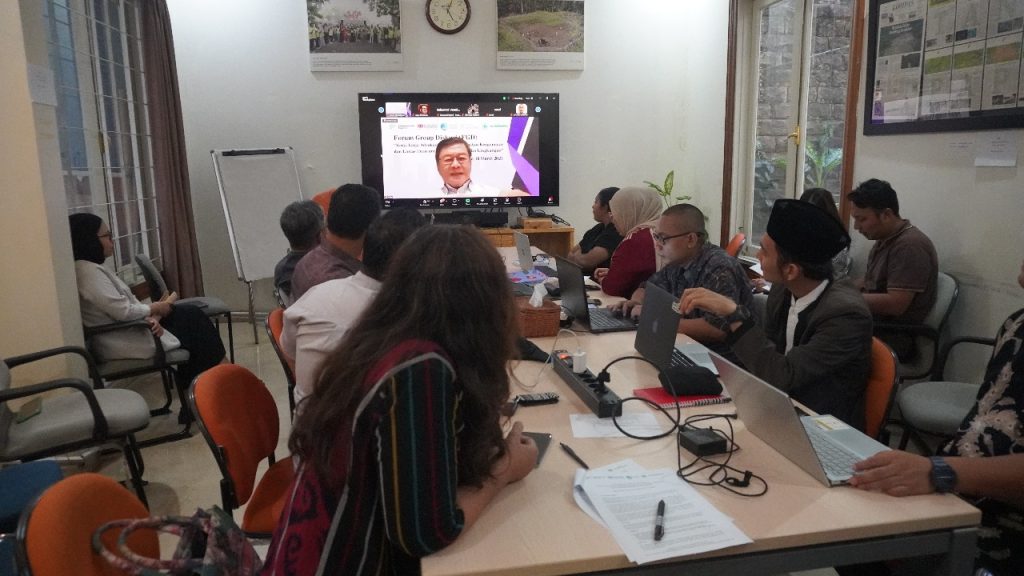
Description: FGD on Advocacy Work in ‘Religious and Interfaith Engagement to Mitigate and Manage Environmental Risks’ on Tuesday, March 18, 2025, held in a hybrid format in Jakarta.
Indonesia, with its abundant natural wealth, is often referred to as the “lungs of the world.” However, behind its beauty and biodiversity, the country faces increasingly complex environmental challenges.
Deforestation, climate change, and pollution have threatened ecosystems and the lives of local communities.
In confronting this crisis, the role of religion and belief systems becomes crucial.
Religion not only teaches spiritual values but also moral responsibility toward nature and the environment.
This is the foundation of the Forum Group Discussion (FGD) held on March 18, 2025, initiated by Eco Bhinneka Muhammadiyah, Green Faith Indonesia, in collaboration with the Interfaith Rainforest Initiative (IRI), and supported by Bappenas and the UK Government through Oxford Policy Management Limited (OPML).
The goal of the FGD is to identify effective strategies for fostering interfaith cooperation to manage environmental risks and promote low-carbon development.
Speakers from various religious backgrounds and environmental experts gathered to share their perspectives and experiences.
One of the key speakers, Dr. Hayu S Prabowo from the Interfaith Rainforest Initiative (IRI) Indonesia, emphasized the importance of interfaith collaboration in the protection of tropical forests.
Hayu stated that forests not only function as the lungs of the world but also serve as homes for biodiversity and indigenous communities. However, the ongoing deforestation threatens the continuity of tropical forests, especially in countries like Indonesia. In the effort to protect tropical forests, the Interfaith Rainforest Initiative (IRI) stands as a movement for interfaith collaboration that aims to unite the moral voices of religious leaders to protect the forests.
“By utilizing the moral influence and global networks of religious organizations, IRI hopes to create significant change in efforts to preserve tropical forests,” said Hayu.
Faith-based organizations (FBOs) play a crucial role in environmental issues. They not only possess assets such as places of worship, educational institutions, and land, but also have vast networks and strong moral influence.
Through this collaboration, IRI Indonesia is committed to protecting tropical forests and promoting sustainable development for a better future for all.
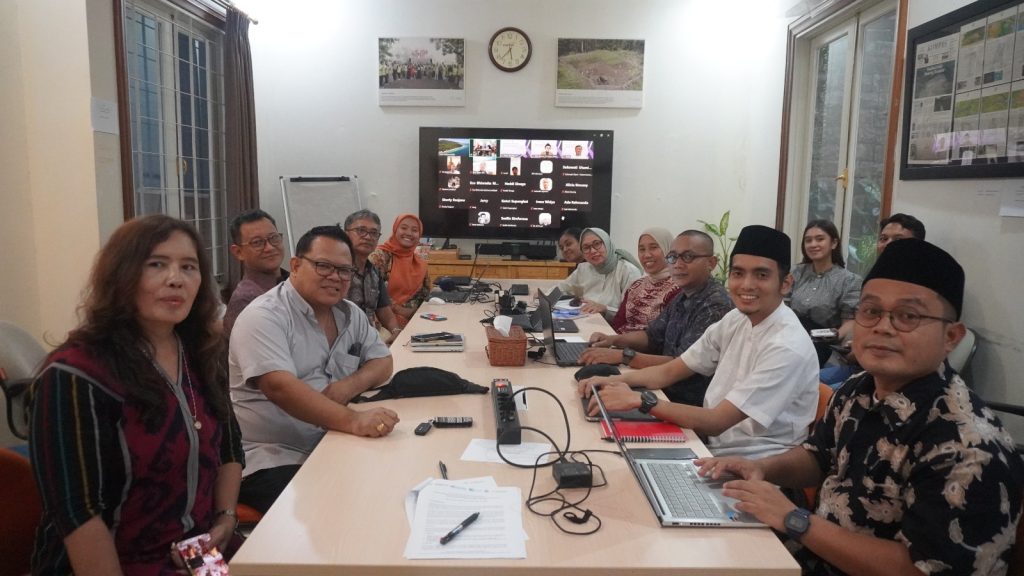
Description: FGD on Advocacy Work in ‘Religious and Interfaith Engagement to Mitigate and Manage Environmental Risks’ on Tuesday, March 18, 2025, held in a hybrid format in Jakarta.
Indigenous Peoples: The Forgotten Guardians of the Forests
Abdon Nababan from the Indigenous Peoples’ Business Agency (BUMMA) highlighted the urgency of the Indigenous Peoples’ Bill to save the forests and indigenous communities.
Indigenous peoples have long been the guardians of forests, but their existence is threatened by industrialization and policies that are not in their favor.
“They possess traditional knowledge in managing natural resources sustainably, but they are often victims of human rights violations and criminalization,” said Abdon Nababan.
The Indigenous Peoples’ Bill is expected to provide legal certainty for indigenous communities.
One of the important proposals from the Alliance of Indigenous Peoples of the Archipelago (AMAN) is the establishment of a National Commission for Indigenous Peoples with the authority to verify, document, and resolve disputes.
Furthermore, the urgency of indigenous communities is also crucial in protecting the communities that protect the forests.
“Indigenous communities in Indonesia continue to face agrarian conflicts in forest areas. To date, there are over 100 recorded cases on the ground. This highlights the importance of the Indigenous Peoples’ Bill in Indonesia,” added Abdon.
According to Abdon, indigenous communities have proven their ability to protect the forests. This can be seen from the data on primary forests that have been preserved in indigenous territories covering 14,008,795 hectares.
Meanwhile, secondary forests in indigenous territories are recorded at 7,246,658 hectares.
“This is once again proof that indigenous peoples, or first nations, are capable of protecting forests and contributing to emissions reduction or low-carbon development,” he emphasized.
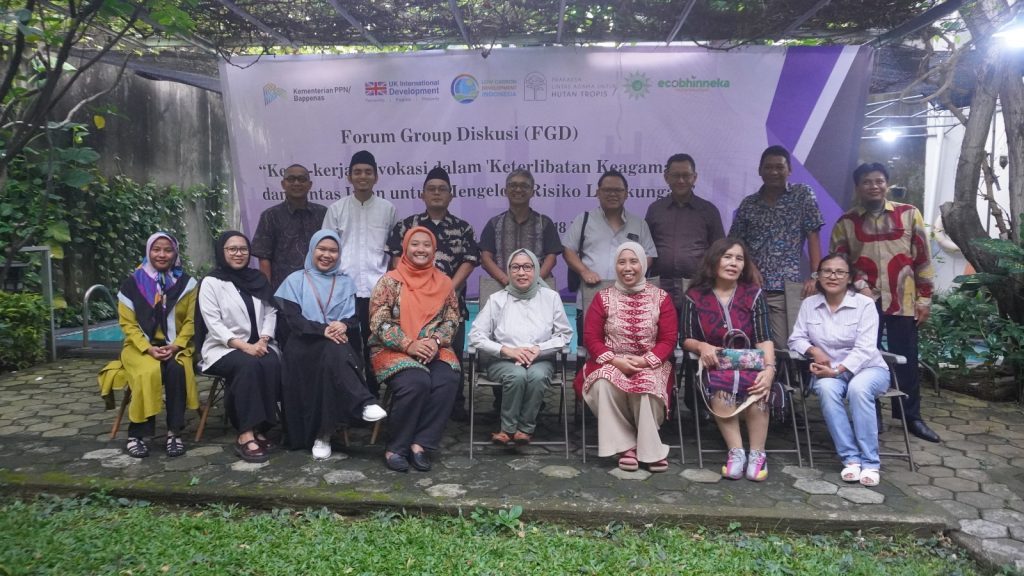
Description: FGD on Advocacy Work in ‘Religious and Interfaith Engagement to Mitigate and Manage Environmental Risks’ on Tuesday, March 18, 2025, held in a hybrid format in Jakarta.
Women and Forests: Protecting Spirituality Across Faiths
Hening Parlan, Director of Eco Bhinneka Muhammadiyah, brought a gender perspective, highlighting the role of women in forest conservation from an interfaith standpoint.
Hening emphasized that forests are not just collections of trees and wildlife. They are sources of life, places where humans and nature are connected in an eternal harmony.
“For women, the forest holds a deeper meaning. They not only see the forest as a source of livelihood but also as a spiritual space that teaches patience, resilience, and wisdom,” she explained.
Hening, who is also the Director of GreenFaith Indonesia, emphasized the importance of forest protection and advocacy for tropical forest conservation in Indonesia through interfaith collaboration.
According to her, the interfaith approach in advocacy has unique characteristics that distinguish it from other methods of advocacy.
“Interfaith collaboration in forest protection advocacy can use faith-based values as a means of enlightenment, preaching, or socialization. This approach can be delivered through sermons, prayers, or other methods commonly used in religious activities, allowing the advocacy process to proceed smoothly and be more accepted by the community,” said Hening Parlan.
Furthermore, she stressed that advocacy efforts require clear goals. However, the steps taken should not be confrontational but must be carried out with wise and effective strategies.
A more subtle approach, based on religious values, is expected to strengthen public awareness of the importance of forest protection as part of moral and social responsibility.
Hening Parlan’s statements align with the views of various religious leaders who also emphasize that the environment, including tropical forests, is a trust that must be jointly preserved.
By prioritizing interfaith cooperation, environmental advocacy is expected to have a broader and more sustainable impact.
The Role of Religious Leaders in Non-Violent Direct Action
In a reflection on the role of religion in the struggle against corruption and environmental degradation, Bustar Maitar, CEO of Eco Nusa, expressed the importance of “Non-Violent Direct Action” (NVDA) as part of the campaign.
Bustar also noted that in many cases, religious leaders can serve as moral voices in social movements, as seen by religious figures supporting the Indigenous Peoples’ Bill or praying for the punishment of forest destroyers.
==
About Eco Bhinneka Muhammadiyah
Muhammadiyah initiated Eco Bhinneka to promote religious harmony in Indonesia through environmental approaches. In 2025, Eco Bhinneka Muhammadiyah and Oxford Policy Management Limited (OPML) are conducting consultations on advocacy efforts involving religious and interfaith participation to mitigate and manage environmental risks in Sawahlunto (West Sumatra), Pekanbaru (Riau), and Ambon (Maluku). The aim is to strengthen the role of religion and interfaith cooperation in managing environmental risks and climate change. In this initiative, Eco Bhinneka Muhammadiyah collaborates with GreenFaith Indonesia.
About IRI (Interfaith Rainforest Initiative) Indonesia
The Interfaith Rainforest Initiative (IRI) Indonesia is a platform for all religious leaders and religious communities to work together with indigenous peoples, governments, civil society, and businesses in protecting tropical forests and safeguarding indigenous communities as forest guardians.
About LCDI
Low Carbon Development Indonesia (LCDI) is a development platform aimed at maintaining economic and social growth through low greenhouse gas (GHG) emission development activities while minimizing the exploitation of natural resources. This program encourages sustainable development that balances economic, social, and environmental sustainability needs.
About GreenFaith Indonesia
GreenFaith is an interfaith organization based in New York since 1992 and now active in 11 countries. GreenFaith is a movement that promotes interfaith cooperation to reduce the impacts of climate change. In Indonesia, GreenFaith has been active since 2023, focusing on Faith for Climate Action, which involves cross-faith individual actions to address climate change impacts, interfaith training for climate justice, and building interfaith perspectives on energy transition. Updates on GreenFaith Indonesia’s activities can be followed on Instagram @greenfaith.id.
