


Description: Puput from Yayasan Empatiku introduced the Gerakan Aku Tangguh program which aimed to build resilience from the ground up asthe frontline in countering extremism, on May 15, 2025 in the Central Board of Muhammadiyah Office, in Central Jakarta.
Yayasan Empatiku and Eco Bhinneka Muhammadiyah are exploring a partnership to strengthen community resilience against violence-based extremism through approaches that emphasize diversity, social inclusion, and ecology. The meeting held at the Muhammadiyah Central Board Office in Central Jakarta on May 15, 2025, brought together two major initiatives working on grassroots peacebuilding and community empowerment.
“For a long time, communities have only been targets of radical narratives spreading through digital and social channels. Through the Gerakan Aku Tangguh (GAT), we aim to build resilience from the ground up, together with women, youth, and local communities who can act as the frontline in countering extremism,” said Rizki Putri Ayudini (Puput) from Yayasan Empatiku.
“At EMPATIKU, we work to strengthen community resilience through three main pillars: early detection and response to violent extremism, community-based social reintegration, and data-driven policy advocacy. One of our key approaches is establishing the Tim Tangguh—community units capable of recognizing early warning signs, responding empathetically, and supporting reintegration processes for individuals and families affected,” Puput explained.
“We also actively encourage the participation of women and youth, as they are the most vulnerable yet strategically important groups. Through digital literacy training and peace narrative campaigns, we aim to combat the spread of extremist propaganda, especially targeting social media spaces,” she added.
Hening Parlan, Director of Eco Bhinneka Muhammadiyah, stated that ecology and diversity are highly relevant peaceful approaches within the Indonesian context. Eco Bhinneka, a Muhammadiyah unit focusing on diversity, harmony, and ecology, believes, “Peacebuilding is difficult through formal dialogue alone, but environmental activities make it easier and more universal. This approach is very effective,” she said.
She emphasized Muhammadiyah’s philosophy as a “House of the Ummah,” which adopts an inclusive concept prioritizing vulnerable groups such as the poor and orphans. “Today’s poverty challenges are not merely economic but also include limited access to knowledge, which worsens inequality,” she continued.
According to Hening, the collaboration with Empatiku will strengthen Eco Bhinneka Muhammadiyah’s ongoing SMILE and ESA programs by integrating digital literacy, empathy, and peace content brought by Empatiku.
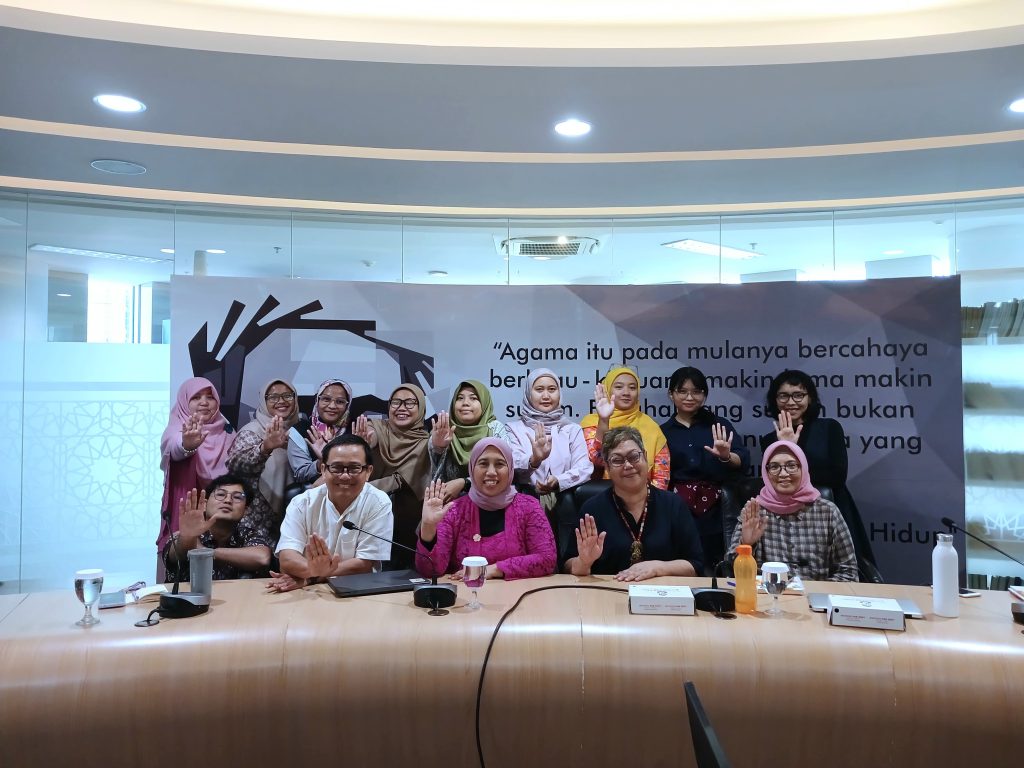
Description: Group photo of Yayasan Empatiku and Eco Bhinneka Muhammadiyah, with high-five pose as a sign to stop the extremism.
Since 2021, Eco Bhinneka Muhammadiyah has implemented various innovative programs, including the JISRA Program to enhance strategic religious actions; 1000 Cahaya, a renewable energy initiative targeting schools, Islamic boarding schools, mosques, and local branches; SMILE, which highlights women’s roles in climate justice; and the Spiritual Inspired Changemakers Initiative (SICI), which builds networks of interfaith leaders for peaceful leadership. Each program is designed with inclusivity, spirituality, and community resilience as its foundation.
In this collaboration, both parties plan to develop an annual program. Activities may include Training of Trainers (ToT) for ‘Aisyiyah communities and various Eco Bhinneka Muhammadiyah program locations, capacity building for former offenders’ groups in Garut, and fostering interfaith tolerance movements through community-based activities. The focus on vulnerable groups such as youth and women will be the common thread throughout all activities.
