

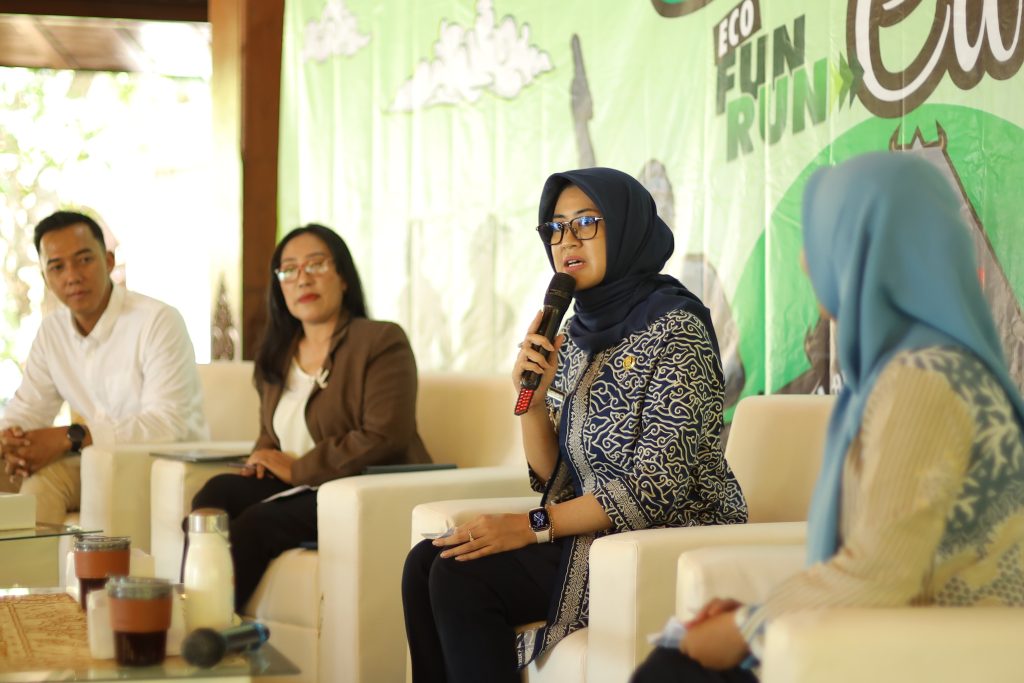
Description: Surakarta Deputy Mayor Astrid Widayani as the speaker of Srawung Carito Forum held by the Eco Bhinneka Nasyiatul Aisyiyah on Sunday, April 27, 2025 in Pendopo Alun-Alun Surakarta
Surakarta — The Surakarta City Government reaffirmed its commitment to promoting circular economy practices as part of its long-term sustainable development strategy. This was conveyed by Surakarta Deputy Mayor Astrid Widayani during the Srawung Carito forum, a key component of the Eco Fun Run event organized by Eco Bhinneka Muhammadiyah–Nasyiatul Aisyiyah Surakarta on Sunday (April 27, 2025).
In her remarks, Astrid emphasized that environmental preservation cannot be the sole responsibility of the government. Sustainability, she said, must be a shared responsibility involving individuals, communities, and educational institutions. “Today, we are not just discussing recycled products, but looking at sustainability through multiple dimensions of life. Protecting the environment is a collective duty,” she stated.
Astrid highlighted the importance of youth participation in the forum as a promising sign. “Seeing so many young people here gives me hope—they are becoming aware and willing to be part of the solution for humanity’s future,” she added.
She also called on the public to be more appreciative of Indonesia’s natural wealth, contrasting the country’s abundant green spaces with the scarcity experienced in other regions. “In the northern parts of the world, simply seeing the sun is something to be grateful for. Meanwhile, we live in a lush tropical country, yet we often complain. This is a matter of cause and effect—if we fail to care for the environment today, we will surely face the consequences in the future,” she warned.
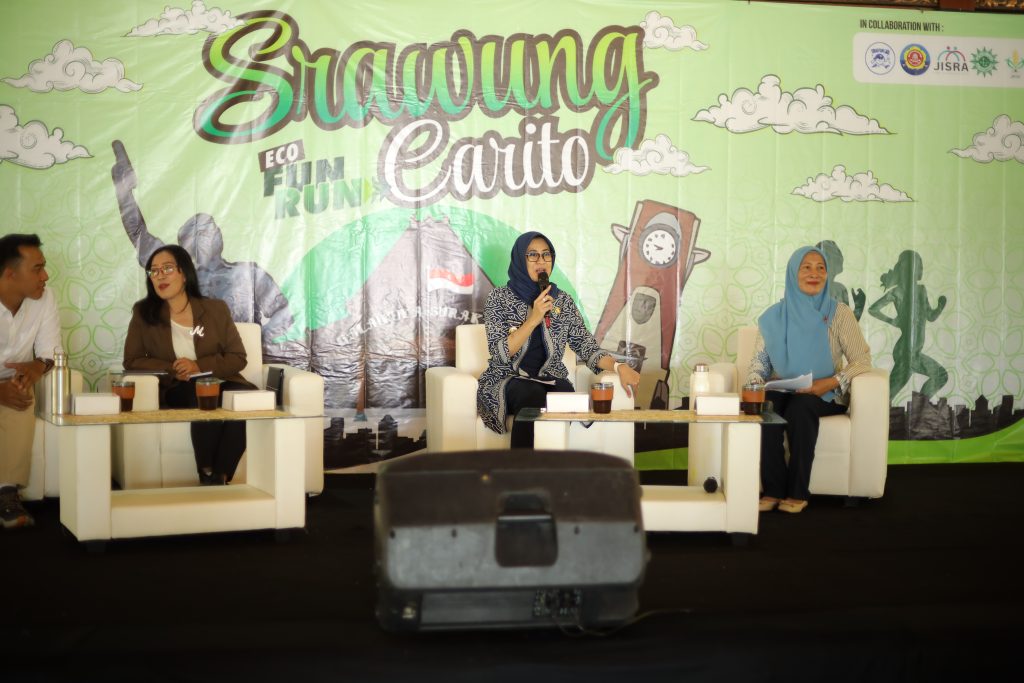
Description: Surakarta Deputy Mayor Astrid Widayani as the speaker of Srawung Carito Forum held by the Eco Bhinneka Nasyiatul Aisyiyah on Sunday, April 27, 2025 in Pendopo Alun-Alun Surakarta
Further, Astrid stressed that circular economy is not just a concept, but a practical solution that can be applied in daily life. She cited examples from the MSME and hospitality sectors in Surakarta, such as converting food waste and textile scraps into economically valuable products.“We often forget to ask: where do production leftovers go? If they’re not being reused, we’re essentially throwing away economic potential,” she remarked.
She outlined three core principles of the circular economy: minimizing waste and pollution; optimizing the circulation of products and materials; and regenerating natural systems. Real-world applications she mentioned include making bags from old newspapers, sofas from used tires, and tree-planting programs such as the nationwide initiative to grow one million matoa trees.
Astrid also commended the work of Carefood, a community initiative in Solo Raya that has successfully rescued nearly 40 tons of surplus food and redistributed it efficiently. “This is a concrete step in reducing waste and supporting sustainability,” she said.
In closing, Astrid expressed her hope for continued cross-sector collaboration. “When communities, governments, academics, and the public unite, a circular economy is not only possible—it can become a major force for a sustainable future,” she concluded.
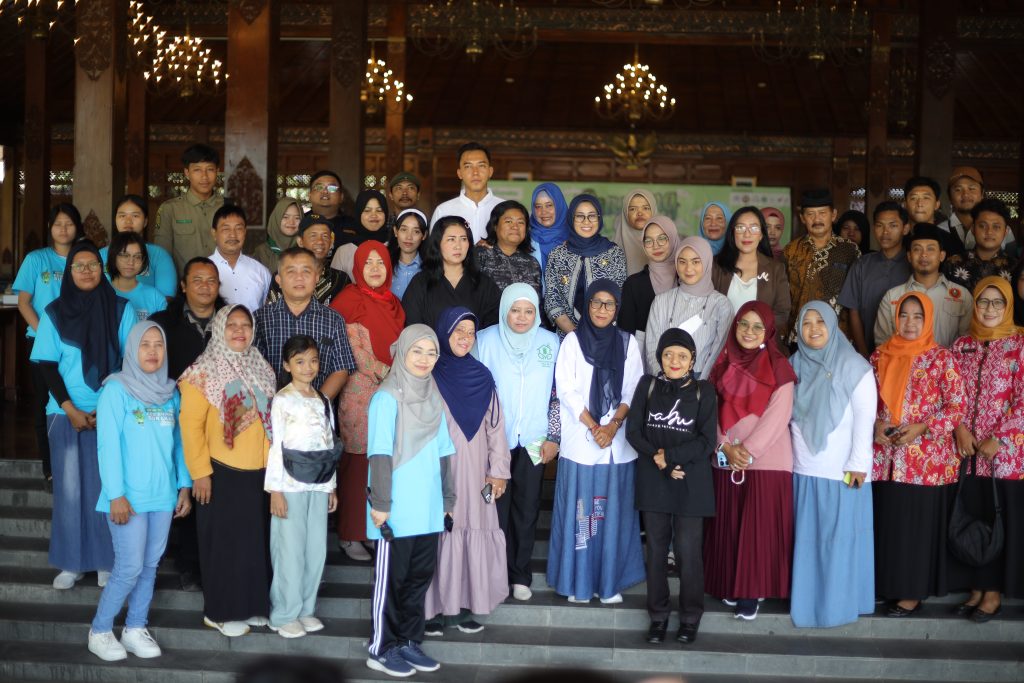
Description: Photo group with Surakarta Deputy Mayor Astrid Widayani on Sunday, April 27, 2025 in Pendopo Alun-Alun Surakarta
